


Have you ever felt like you’re watching a play where you’re somehow both the lead and the supporting cast? If so, you’re not alone.
How do you stay centered—and hopeful—when chaos seems to be the backdrop, when the improbable keeps becoming reality?
As Simon Sinek reminds us, it starts with the why. When you have clarity and conviction about what you’re here to do, that sense of purpose can move mountains. But before you begin, it’s worth asking:
Is this mountain worth moving?
Is it ready—and are the conditions right?
Do you have the skills, influence, and resources to sustain the effort?
Is this the right moment to act?
Will the impact create positive momentum beyond the initial push?
And is it aligned with your values—and the legacy you want to leave?
If you have your WHY, and the answers to the questions are yes, read on.
This month’s Humans Over the Loop article explores what comes after why—how to decide whether to lead, manage, or oversee AI to create real impact.
Our Humans In the Loop piece dives into practical scenarios and best practices for shifting between these roles in the Age of AI.
The next section of the newsletter features the web apps we’ve been creating. Leveraging more than twenty years of facilitating leadership and innovation through FountainBlue’s advisory, consulting, and coaching work—and my earlier experience launching and growing a web development firm—I’ve created a suite of interactive tools that executives, managers, and their teams can use to better assess, plan, pivot, grow, and manage their organizations, teams, and individual contributors. One of these web apps is featured below.
If you’re curious how they might support your team or your own leadership, just reply to this newsletter and I’d be happy to walk you through a short demo.
Lastly, we’re including Chapter 7 from of our Hope in an Age of Disillusionment book.
Humans Over the Loop: Beyond the Why is the What, the How and the Who

For over twenty years, I’ve watched leaders wrestle with a very human version of the same question: how do I lead well when everything keeps changing?
In rooms full of smart, accomplished people, someone eventually looks past the latest AI slide or 10x productivity claim and you can almost hear the unspoken question:
“And what does that mean for me now?”
Not “What does this mean for my tech stack?”
Not even “What does this mean for my org chart?”
But much closer to: “Who am I in all of this—and how do I stay relevant, useful, myself?”
AI has the edge on speed and pattern‑matching. It is tireless. It is spectacularly good at certain kinds of prediction. But AI is not the one:
Sitting across from the employee wondering if their role still matters
Choosing between speed and fairness when the trade‑offs get real
Carrying the long‑term story of what you—and your organization—stand for
That’s still us.
So the questions underneath the questions are not “What can AI do?” but:
Where are we going?
How do we steer and oversee the path?
How do we stand for our values and intentions while we do it?
The three lenses, the three hats
If you’re clear on your “why,” and clear on whether something should be done, the next step is to focus on two linked ideas: how you see the situation and how you show up in it.
Lenses – how you see the situation, what you pay attention to
Hats – how you show up and act in response
There are three core lenses—and three corresponding hats—we all move between:
To lead with intention and direction
To manage with fortitude and agility
To oversee with diligence and judgment in an AI‑enabled world
The lens shapes your vision of what’s happening and what matters. The hat shapes what you actually do next. Most of us cycle through all three, often in the same day.
As leaders, we look through a lens of purpose and possibility, then put on the hat of defining the north star, setting values and boundaries, and making meaning so others can act with confidence.
As managers, we look through a lens of execution and coordination, then put on the hat of translating intentions into workflows, roles, and rhythms that actually deliver results.
As humans overseeing AI, we look through a lens of risk, ethics, and interdependence, then put on the hat of deciding when to invite tools in, how to interpret their outputs, and where accountability must stay firmly human.
When vision and action get out of sync
Most of us don’t look through a single lens or wear a single hat all day. In the same meeting, you might be:
The leader people look to for direction and meaning
The manager people count on to make the work actually flow
The human overseeing the AI that sits in the middle of the conversation
If we’re not careful, the lenses blur and the hats slip.
We over‑lead: seeing everything as a vision problem and trying to define it all from the top, instead of making space for management and oversight.
We over‑manage: seeing everything as an execution problem and keeping things moving—even when we’re moving in the wrong direction.
We over‑delegate to AI: seeing everything as an efficiency problem and letting the system decide, while we sign off at a distance.
The art is in noticing: Which lens should I be looking through right now? Which hat is this moment actually asking me to wear? And then having the discipline to adjust both—clarifying how you see, and choosing how you act—with intention.
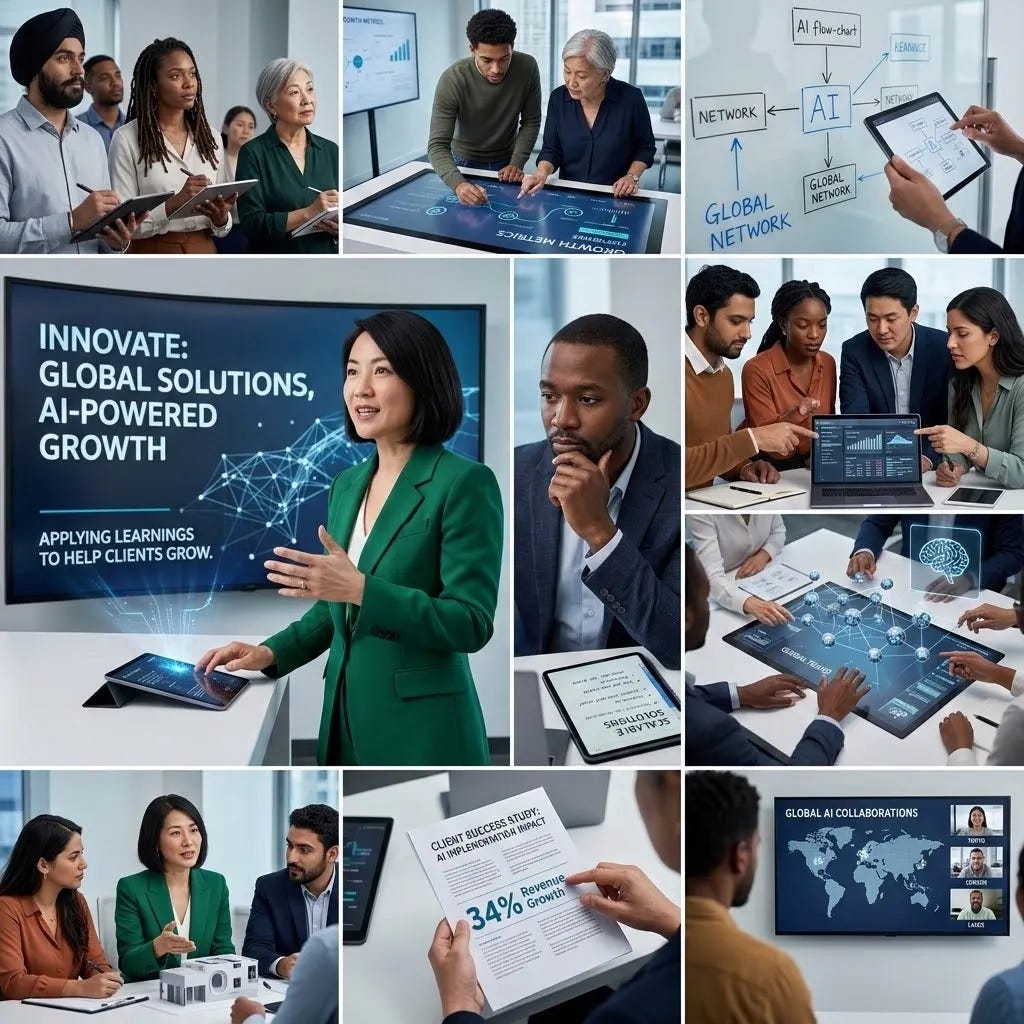
Humans in the loop, on the loop, over the loop
There’s a quiet, very human moment I keep seeing in rooms full of smart, accomplished leaders.
Someone glances at yet another AI slide—another promise of 10x productivity, another chart about disruption—and you can almost hear the unspoken question:
“And what does that mean for me now?”
Not “What does this mean for my tech stack?”
Not even “What does this mean for my org chart?”
But, more simply: “Who am I in all of this?” and, with anxiety, “How will I remain relevant now?”
In the age of AI, that’s the question underneath the questions. It’s the one we don’t quite dare speak out loud.
AI has the edge
AI is fast. It is tireless. It is spectacularly good at certain kinds of pattern‑matching and prediction.
But AI is not the competition. With a “this and” mindset, remember that AI is not the one:
Sitting across from the employee who’s wondering if their role still matters
Choosing between speed and fairness when the trade‑offs get real
Carrying the long‑term story about what your cause, your organization, you personally stand for
That’s still us, as humans.
The pace has changed, of course. Decisions come at us in a rush. There’s less time to think, more pressure to act, and an endless stream of “coulda, woulda, shouldas” in front of every leader:
We could automate this.
We could optimize that.
We could let the model decide here.
The real question is NOT “What can AI do?”
The real questions are “Where are we going? How do we oversee the path?” and, most importantly, “How can we stand for our values and intentions while steering the course?”
That’s where the distinction between leading, managing, and overseeing AI stops being theoretical and starts being deeply personal.
Lean into your human‑ness
At any given moment, you can choose how to show up—as a leader defining “why,” as a manager designing “how,” or as a human overseeing AI and exploring “what if.”
You might need to name the values, draw the boundaries, map the workflow, clarify roles, unblock a stuck team, or invite AI to propose, predict, or synthesize—and then bring your judgment to bear.
Nobody will tap you on the shoulder and assign you this work, and it’s unlikely anyone will thank you for doing it.
But this is your chance to notice the moment, see the opportunity inside the challenge, and step in, step up with intention.
That, to me, is some of the most human work there is.
From conversations to web apps

FountainBlue’s suite of web apps extends and supports this advisory, consulting, and coaching work with practical, decision‑ready tools for leaders, managers, and boards. These apps turn real‑world AI questions into structured scenarios, assessments, and dashboards you can use between conversations, so you can bring more prepared, grounded thinking back into the room.
One example is our Lead | Manage | Oversee Navigator. Instead of talking about AI in the abstract, it walks you through practical, real‑world situations—from automating part of a workflow to rolling out an AI‑powered feature—and lets you explore each decision from several angles: setting direction as a leader, driving execution as a manager, and overseeing AI as a human responsible for judgment, ethics, and accountability. The point isn’t to find a single “right” stance, but to surface trade‑offs, clarify roles, and make it easier for people to work together when the stakes are high and the timeline is short.
Think of it as a safe place to ask “what if?”—within small, tight, or even large circles—before you commit to “we will.” If you and your team are already asking “Where does AI truly add value here?”, “What are we optimizing for—speed, fairness, learning, resilience?”, or “How do we keep our people at the center, even as we automate more?”, this app is for you. AI may have the edge on speed and pattern‑matching, but only humans can decide what “worth it” really means. For more, you can explore the full suite of web apps, reply to this newsletter and request details, or schedule a no‑obligation demo.
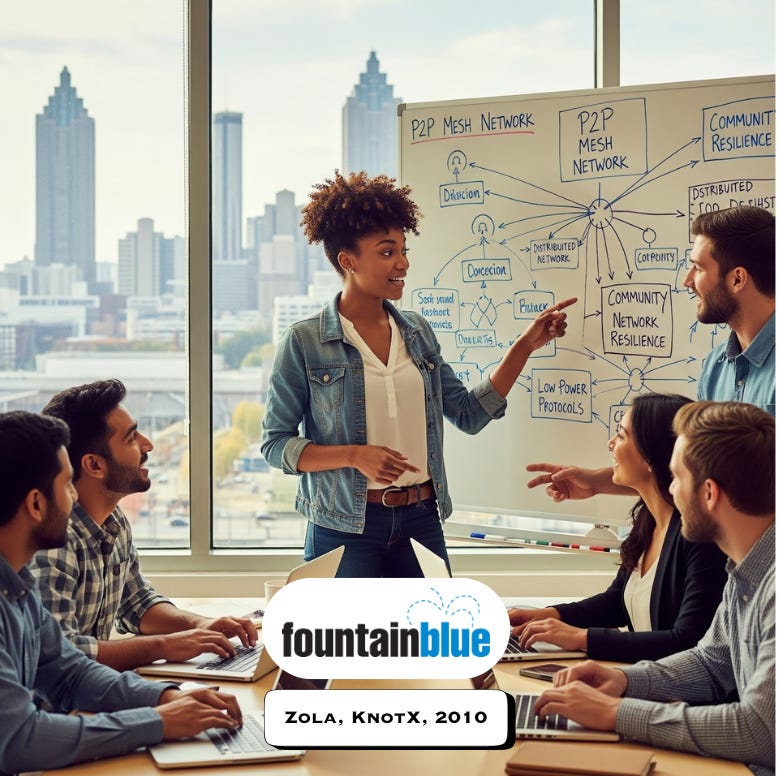
Chapter 7: The Community Mesh (2010-2015)
Hope is Collective Trust.
The strongest defense is the network you build yourself.
The Resilient Divide (The Times)
The years 2010 through 2015 were defined by a profound asymmetry of connection. The smartphone revolution made universal mobile connectivity an expectation, yet this technological triumph concealed a fundamental moral failure: Infrastructure Inequity. Telecommunications giants invested only where profits were more tangible and easily obtained (dense urban areas), leaving rural and low-income communities with brittle, antiquated, and unreliable service.
This failure was brutally exposed by the increasing severity of natural disasters. When these centralized systems failed, the profit-driven model revealed its moral limit: those with the least resources were left utterly disconnected.
This stark reality fueled a public demand for corporate accountability. However, corporate commitments were often undercut by prioritizing marketing social good over genuine systemic change, leading to deep public cynicism. The cumulative effect was a sense of profound disillusionment that technology, when governed by pure profit, actively amplified social inequality and was structurally incapable of providing basic human safety in a crisis.
The Entrepreneur’s Perspective: (The Voice of Zola)
Growing up as a Black American in Atlanta, I saw the contrast between the city’s high-tech corridors and the neighborhoods where my grandmother lived, where storms meant losing connection right when people needed it most. Wanting to help, I joined a Fortune 500 company in 2010, hoping a technical role would make a real difference. But as time passed, I realized my passion was less about corporate networking and more about building solutions with and for the communities I cared about. I wanted to work closer to the ground, where the impact would be felt directly.
I started tinkering at home, trying to understand where the system was fragile. My early ideas were clumsy — attempts to build stronger hotspots or local boosters that collapsed under the strain of too many devices. I kept failing. But every failure taught me where the real pressure points lived.
The breakthrough came from a simple question:
What if the network did not depend on a single tower?
What if people could rely on one another?
I began sketching a peer-to-peer model where devices in a community supported each other, forming a flexible mesh that stayed alive even when one part failed. It was the opposite of the centralized system I worked in every day. The prototype was rough, barely stable enough to keep a connection alive for more than ten minutes. But it proved the idea wasn’t impossible.
Atlanta, with its sharp divides and intense pride in neighborhood identity, became the perfect ground to test something built on shared reliability. I gathered a team of engineers, entrepreneurs, students, and community volunteers who shared one belief: people deserved dependable communication regardless of their zip code.
We named the system KnotX to reflect what we wanted to build: a series of strong, intentional ties forming a network more resilient than any single point could ever be on its own. We designed KnotX as a routing protocol that let each device decide the best way to pass along a signal, like neighbors handing messages down the block until it safely reached its destination.
Our technical anchor was a lightweight routing protocol that allowed each device to automatically decide the best way to pass along a signal. No single machine carried the burden; the community carried it together.
Our first measurable win came during a neighborhood stress test. When a temporary outage hit, the centralized service stayed down for hours — but KnotX reconnected our pilot area in six minutes and twenty-two seconds. Residents celebrated, the local paper covered it, and for the first time, the idea felt real. KnotX had a long way to go, but it finally had a pulse — and we were ready to defend it.
The Mentor’s Intervention (the voice of retired telecommunications executive Samuel Levy)
Reading the Atlanta paper, the headline — “Community Network Beats Telecoms in Storm Recovery” — nearly made me spill my coffee. For twenty years, the reliability plans I proposed were dismissed in favor of higher-revenue strategies for more profitable regions. Every time I pushed to strengthen service in underserved communities, I was told it was “not a priority,” “not in the budget,” or “not aligned with strategic markets.” That quiet failure stayed with me.
KnotX was the very architecture I was never allowed to build. The six-minute-and-twenty-two-second uptime wasn’t just a technical victory — it was proof of what corporate greed had denied for decades.
My curiosity was as much about the technology as it was about the ability to overcome the human obstacles to creating a scalable, equitable infrastructure.
When we met, I realized that Zola had incredible vision and technical brilliance, but she lacked the institutional credibility to convince major partners to engage.
I shared the bureaucratic and revenue-first objections I faced. We began brainstorming to navigate those obstacles, focusing on delivering the core business case.
I proposed a partnership: I would provide investment, access to industry knowledge, and the rigorous testing required to meet national standards. Zola’s team would transform KnotX from a one-community breakthrough into a nationwide blueprint. We reached an enthusiastic agreement and began the mission.
Better Together
Working together, Zola and Samuel focused on one goal: turning KnotX from a neighborhood experiment into a reliable model that other communities could adopt. They knew the technology worked, but they also knew that real scale required structure, discipline, and clear responsibilities.
Their first challenge was creating a system that volunteers could operate confidently. The early meetings were difficult. Samuel pushed for formal documentation and controlled testing environments, while Zola preferred rapid iteration and hands-on problem solving. It took several long nights before they agreed on a framework that honored both approaches. They built a simple operational manual, trained local volunteers, and automated every critical function the team could not afford to leave to chance.
The next test came when Zola’s grandmother’s neighborhood suffered another power outage. The centralized grid stalled, but KnotX recovered and stabilized within minutes. Over the next two weeks, the team tracked every metric they could. Connection reliability increased, emergency messages were delivered faster, and residents reported a measurable reduction in outage-related disruptions.
Word spread quickly. Nearby communities asked for help replicating the system, but scaling raised new challenges. Some neighborhoods lacked volunteers with technical experience. Others worried about security or questioned whether a community-run network could stay reliable without corporate oversight. Each concern forced the team to clarify training, tighten security protocols, and improve the handoff process between local teams.
Progress accelerated when Samuel introduced KnotX to a national organization focused on disaster preparedness. The partnership opened doors to structured funding and allowed Zola’s team to run pilots in multiple regions. Within six months, the participating communities reported measurable improvements: faster restoration of communication during outages, higher volunteer engagement, and more stable peer-to-peer connections under stress.
One of the most meaningful milestones came when a rural county tested KnotX during a regional storm. Their centralized network went down for hours, but the KnotX mesh stayed active and allowed residents to coordinate check-ins, supply runs, and emergency assistance. The county’s report credited KnotX with preventing several medical delays and improving community responsiveness during the event.
Together, Zola and Samuel proved that resilience grows from collaboration. Their work showed that when communities participate in their own infrastructure, they do not just stay connected—they grow stronger.
Hope is Collective Trust:
The strongest system is the one built by its own members.
Whether it’s through web applications, one-on-one coaching sessions, or consulting and advisory projects, FountainBlue is focused on how we can each better lead, manage, oversee, and succeed in spite of—and also because we are now living in—the age of AI. Each FountainBlue coaching and consulting client will receive their choice of one of the following complementary gifts:
a regular or workbook edition of Hope in an Age of Disillusionment
access to FountainBlue’s Hope Toolkit Companion web app
one HOTL or HITL micro training session
For more information, visit our web site, see our author page, or email us now.