



From my earliest memory, I’ve been hungry for knowledge—yet I was always the one who would turn that knowledge on its head, the one who would take a test from the bottom up, the one who would always ask: but why?
There was usually a reason for the choices I made. You start from the bottom of the test because teachers sometimes put the answers to earlier questions further down the page. And if you ask the deeper why, you often uncover deeper insights and deeper questions.
So I’m dedicating this month’s newsletter to that side of me—the side that’s hungry for the learnings, yet forever turning those learnings on their head. In these troubling, uncertain times, taking that “different” approach—seeking deeper insights, seeing things differently—might be exactly what leads us into something bigger and brighter.
This month’s advisory web app is Stars, Ruminants, Strays, and Elitists. It turns the old Stars/Cows/Dogs/Unknown 2x2 matrix on its head and creates more opportunities for more people and initiatives to shine brighter for longer.
This month’s consulting web app is Delegate, Orchestrate, Collaborate. It helps clarify when you should delegate an automation to AI and oversee its delivery, when you must orchestrate between tools, agents, and humans, and how you can collaborate with AI to brainstorm what else can be delegated and orchestrated.
This month’s coaching web app is Challenges to Opportunities. FountainBlue designed this tool to support coaching clients as they frame strategic, operational, and people challenges into opportunities by building more clarity, more initiative, and more resilience — which lead to specific measurable impact.
We are now on Chapter 8, the penultimate chapter for our book Hope in an Age of Disillusionment, featuring Aya, and her solution PROOVN, an authenticity engine.
This month’s Advisory app:
Stars, Ruminants, Strays, and Elitists
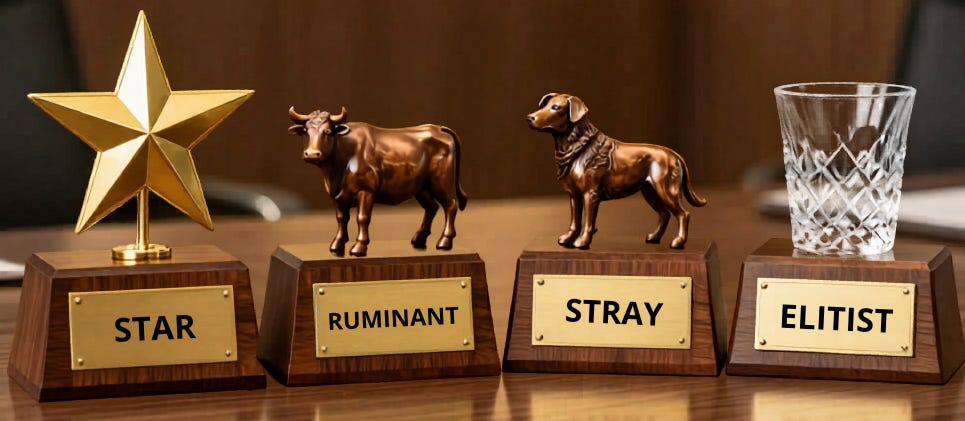
It is time to upgrade the “Cows and Dogs” matrix many of us learned in business school, where “cows” are products of the past and “dogs” are offerings that may not be worth keeping.
In the Age of AI, leaders need a more hopeful, dynamic way to look at their portfolios. Instead of treating categories as fixed labels, we can use them as starting points for asking where each offering might go next.
In this updated view, we still use a two-by-two grid, but we map offerings along two axes: time and margins.
On one axis, we ask: Does this offering generate meaningful revenue today, and is it likely to generate meaningful revenue in the future?
On the other axis, we ask:
Does the economics work—does the value delivered justify the cost and effort to deliver it, in a way that is strong, repeatable, and efficient enough to sustain healthy margins?
Once you look at your portfolio this way, four patterns begin to emerge:
Stars with high margins and strong growth potential over time
Ruminants as formerly glorious offerings
Strays as heavily invested products that did not quite take off
Elitist Solutions that are a good idea but currently expensive and overly niche to command strong margins
Stars
Stars sit in the upper-right: high margins now, strong potential for the future. These offerings have traction, relevance, and momentum. Customers value them. Teams know how to deliver them. They feel like the center of gravity in the business.
But even Stars are not guaranteed. Markets shift. Expectations change. Technology (including AI) opens new possibilities and raises new standards. The question is not just, “How do we protect our Stars?” It is, “How do we help them shine even brighter?”
A Star may be brighter for longer if:
New use cases are discovered and intentionally supported, so the offering solves more than the original problem without losing its core.
New segments are identified and served with thoughtful variants or bundles, extending relevance beyond the initial ideal customer.
Adjacent markets are explored where the same underlying capabilities create distinctive value, turning a single Star into a small constellation of related offerings.
The roadmap keeps weaving learning from these new use cases and segments back into the core, so the Star grows in depth, not just in surface area.
The goal is not to freeze Stars in place; it is to keep them luminous as the environment changes.
Ruminants
Ruminants are your former Stars: the offerings that once generated strong revenue and may still do so, but whose best growth days are probably behind them. They “chew” on established relationships, familiar markets, and a known way of doing things.
On the grid, Ruminants inhabit the high-margin past, with a less certain future. They have earned their place. They may still be funding new initiatives. But the world around them has shifted.
Ask yourself questions about YOUR Ruminants, including:
Are there adjacent use cases or segments where the existing capabilities would be genuinely valuable without major rework?
Could the core be repositioned for a clearer problem, a more specific customer, or a better-defined job to be done?
Which parts of the product still feel essential and differentiated, and which have become clutter, legacy, or “me too” features?
Is there a dignified next chapter for this offering, or has its strategic role already been fully played?
Some Ruminants can become Stars again through reinvention. Others can be pared back into more focused offerings or spun out as distinct products for specific niches, while some serve best by funding what comes next.
Strays
Strays are offerings that have consumed time, attention, and resources, but have never really earned their keep—and will not, if nothing fundamental changes. They may have been launched for the wrong reasons, aimed at the wrong customer, funded at the wrong time, or built on an unsustainable cost structure. They may have simply wandered away from your true strategy or execution challenges led to under-performing results.
Strays deserve honesty and compassion. The key questions are:
Does this offering address a problem that still truly matters, or has the need shifted elsewhere?
Is there a more specific customer, segment, or use case where the product would clearly fit and win?
If so, what would it take to simplify, refocus, or rename the offering so its purpose is unmistakable?
Are there core capabilities that could be folded into another product instead of standing alone?
If we choose not to evolve it, what strategic space, budget, and attention would be freed up by a kind, intentional sunset?
Sometimes the most strategic action is to let a Stray go. Other times, the work is to narrow its purpose, reposition it for a specific customer or use case, fold its best capabilities into a stronger product, or rename and reshape it so it finally has a clear place in the portfolio.
Elitists
Elitists are bleeding‑edge, high‑touch, expensive‑to‑deliver offerings that serve a narrow, sophisticated audience. They can feel glamorous and genuinely transformative for a handful of clients—but in their current form, they don’t serve enough people, or they can’t serve them efficiently enough to create healthy margins.
The risk with Elitists is that they stay elitist—niche, exclusive, and un‑scalable. The opportunity is to use that intense, early signal to design clearer products, sharper features, and more scalable delivery models, so you can expand the audience and improve margins over time.
The key questions for Elitists are:
What makes this offering uniquely powerful for the small group that loves it today?
Which aspects of that power must we preserve, and which complexities could we simplify or automate without losing the magic?
How might we prototype a simpler, more self‑serve version that keeps the signature value but works for many more customers?
If we get that right, what are the next circles of customers or markets we can responsibly expand into?
In other words: can we turn an Elitist into tomorrow’s Star?
Moving everything up and to the right
The point of this framework is not to sort offerings into good and bad boxes. It is to ask: How could each of these move up and to the right?
A Star can be made brighter and stay relevant longer by expanding into new use cases, segments, and adjacent markets while keeping its core clear.
A Ruminant can be given a thoughtful next chapter—repositioned, refocused, or spun into a more sharply defined offering—or gently retired so it can fund what comes next.
A Stray can be intentionally reshaped for a specific problem and customer, merged into a stronger product, or released to free up strategic space and attention.
An Elitist can be reimagined so its underlying insight becomes more accessible and scalable, evolving from a high‑touch niche into tomorrow’s Star with broader reach and healthier margins.
With these thoughts in mind, FountainBlue designed a Stars, Ruminants, Strays, and Elitists app to help users map their portfolio, sit with what they see, and then ask broader, more hopeful questions about what’s next for their business. The aim is to help users choose the path that moves each offering up and to the right—toward clearer products, broader reach where it makes sense, margins that compound over time, and people who are better supported to make those shifts wisely.
E-mail us your Star, Ruminant, Stray, or Elitist challenge or opportunity.
This month’s Consulting App:
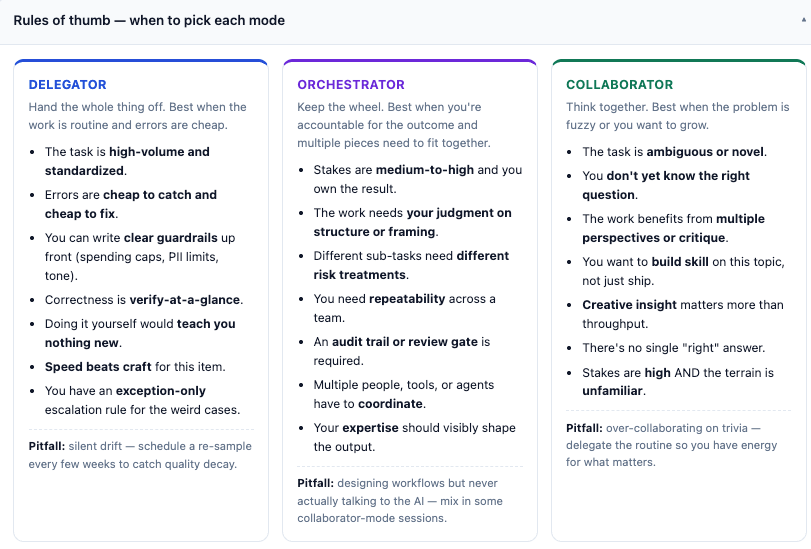
Delegator, Orchestrator, Collaborator
FountainBlue’s Delegate, Orchestrate, Collaborate app gives leaders a simple playbook for deciding what belongs where.
The Delegator hands off repeatable, well-defined work where mistakes are cheap and reversible. Think high-volume, rules-based tasks with clear guardrails and obvious right-or-wrong answers. When you delegate correctly, AI becomes your fast, tireless operator, while humans spot-check for drift instead of redoing the work themselves.
The Orchestrator allows the AI to draft, summarize, or connect the dots, but humans still own the outcome, decide the structure, and coordinate across tools, agents, and people. Orchestrators design the handoffs, insist on review gates and audit trails, and make sure expert judgment shows up in the final result, not just in a forgotten prompt.
The Collaborator leans into AI when problems are messy, questions are fuzzy, and the terrain is unfamiliar—when there is a lot at stake and even more you do not yet know. In this mode, AI helps you generate options, pressure-test assumptions, and surface diverse perspectives, without compromising your values, context, or judgment, and without over-investing the time you do not have.
Collaboration is where you learn fastest—and where overuse is most tempting. By definition, the work is ambiguous, so the easy move is to rubber-stamp whatever the model produces. Choose instead to treat every output as a starting point: something to explore, to refine, to delegate, to orchestrate, and to further brainstorm with your team.
FountainBlue’s Delegate, Orchestrate, Collaborate web app gives your organization a common language for working with AI—so you oversee responsibly, scale systematically, and keep humans both in the loop and over the loop, where leadership belongs.
This month’s Coaching app
Convert Challenges to Opportunities,
with Clarity, Initiative, Resilience

Most leaders are not short on challenges. They are short on clarity, initiative, and resilience when those challenges arrive all at once across strategy, operations, and people. FountainBlue’s Challenges to Opportunities coaching web app is built to change that.
The app helps you break the chaos down into its individual elements. First, it helps you name the challenge clearly and examine it through two lenses: the type of challenge — whether it is strategic, operational, or people-related — and the impact of that challenge across marketing, financial, operational, and people dimensions. That two-lens view moves the conversation from “what is happening to us” toward “what this could mean for us” — with enough specificity to act on.
Instead of revisiting the same stuck issues in every 1:1 or staff meeting, coaches and leaders can use this tool to turn each challenge into a concrete opportunity: a specific experiment to try, a conversation to have, a metric to track. Over time, those repeated moves toward clarity, initiative, and resilience add up—to better decisions, stronger teams, and measurable impact on the work that matters most.

Chapter 8: The Authenticity Engine (2015-2020)
The System of Digital Exploitation (The Times)
The years 2015 through 2020 were defined by a profound crisis of digital exploitation. The world realized that the exponential growth of Big Tech was built on the Betrayal of the Digital Promise, turning user data into the most valuable commodity. This realization was driven home by constant data breaches and public exposure of user manipulation.
This moral chaos was compounded by the rise of sophisticated counterfeiting and intellectual property theft. Digital files - from art to fashion patterns - were instantly stolen and mass-produced without any means of tracking their true origin. The public felt profound anger that the systems they used had become instruments of massive fraud.
Politically and legally, global movements like the General Data Protection Regulation began to push back, attempting to reassert control over user data and the provenance of digital assets. The ultimate crisis was the growing conviction that creators had lost control of their own work - their ideas, their data, and their digital identity.
The Entrepreneur’s Perspective (The Voice of Aya)
In 2015, digital exploitation felt personal. As a technologist and designer of Mexican American and Korean American heritage, I watched my artist friends lose income and recognition to platforms that rewarded copies more than creators. Every week, someone in our circle had a design stolen, remixed, or mass produced without credit. The injustice was relentless and quiet, the kind that drains your resolve unless you decide to fight back.
Tempe had exactly what I needed to support the cause: precision engineers from the university labs, a tight network of Latinx and Asian American artists, and a community that understood the value of original work. It was a place where innovation and craft spoke the same language.
I gathered a small team across Tempe—engineers who had spent years refining micro‑fabrication workflows, artists who knew exactly where counterfeits slipped through, and designers who understood what creators actually needed. Together, we built the early foundation of the system we later named ProovN, because every design deserved a proof of origin. The vision was to create a unique digital watermark for each design—a hidden signature that would break if anyone altered the file—so the original work could always be verified and protected.
Our first verification tag slowed printers to a crawl. The second was faster but failed most integrity checks. Those early attempts revealed how challenging it was to combine such different disciplines, yet also how energizing it felt to tackle the problem together.
A professor who reviewed an early demo told me gently, “Your heart is right, but your math is wrong.” He was right. Each failure made one truth clearer: passion alone could not protect creators. The technology and the creative community had to work as a unified system, where the whole solution was stronger than its individual parts.
The breakthrough came when we created a verification signature based on the unique shape of each 3D design file. It worked like a quiet digital handshake that stayed with the file from the first draft to the final printed piece. If anyone changed anything—a line, a curve, a pattern, or even the production path—the hologram on the finished item would render incorrectly, appearing broken or incomplete. That made true originality visible, and made counterfeiting impossible to hide.
We tested ProovN relentlessly. We ran simulations through the university’s fabrication labs, stress-tested the signature across different materials, and worked with local designers to see whether the system slowed their creative flow. The early numbers kept us going: ProovN blocked 82 percent of unauthorized file manipulations in our first controlled test cycle.
It wasn’t perfect, but it was proof that we were solving a real problem.
The turning point arrived at the Tempe Chamber of Commerce fashion showcase. When the models walked out wearing pieces protected by ProovN, the holograms sparked immediate curiosity. People asked questions, scanned the tags, and realized they were looking at provable originality. Customers lined up asking to buy garments at premium prices, not for exclusivity, but for certainty.
The Mentor’s Intervention (the voice of Javier Diaz, Local Entrepreneur and Sponsor)
My daughter, Alisa, invited me to sponsor the ProovN fashion show. As a designer, she constantly battled the same intellectual property theft I had spent my entire career fighting in commercial printing. For more than three decades, I had grown and expanded my printing business across Tempe’s manufacturing districts, and I saw firsthand how easily a design, pattern, or prototype could be copied and mass-produced without credit or consent. Protecting creators wasn’t an abstract ideal for me — it was a moral obligation shaped by years on the front lines. Supporting Alisa meant supporting every artist who deserved ownership of their work.
I saw the ProovN holograms glinting on those custom dresses. It was proof-of-concept for the most valuable asset in the digital age: verifiable integrity. I immediately saw the opportunity to help Alisa and her generation and also realized that ProovN could be integrated into any multiparty manufacturing process, extending to pharmaceuticals and electronics, for example!
When I met with Aya, I challenged her with the bigger opportunities: Could she scale beyond the creator market? Could she transition ProovN to other markets? Could she govern the manufacturing process at scale?
These were big questions. Aya hesitated, admitting honestly, “I don’t know.”
We decided to start small. I invested, and ProovN pivoted from selling subscriptions to designers to licensing infrastructure to 3D manufacturers in Javier’s network.
Better Together
Integrating ProovN into real 3D manufacturing lines was far from simple. Each facility ran slightly different equipment, and every workflow came with quirks that the team had to learn one by one. It meant long nights debugging misaligned files, reconciling software differences, and persuading veteran technicians that the protocol would not slow them down.
The creative team sometimes grew impatient, frustrated that production fixes delayed their next round of designs. But over time, they began to see the unexpected benefit: working closely with engineering and manufacturing gave them a deeper understanding of how their pieces were actually made. The collaboration made everyone sharper, humbler, and more invested in getting it right.
Inside the manufacturing houses, ProovN eventually became part of the normal rhythm. When a designer uploaded a file, the protocol quietly created its signature in the background. That signature traveled through each stage of production—from print preparation to finishing. Before a piece was released, the system ran a final check. If everything matched the original design, the hologram appeared, confirming authenticity. If anything had been altered or rerouted, the piece simply would not validate. Manufacturers appreciated that the protocol worked without slowing them down, while still protecting both the creators and their own operations.
Javier helped accelerate adoption by supporting the first sets of manufacturer pilots, giving companies a safe, low-risk space to try ProovN. Once those initial partners saw how the hologram verification reduced disputes and strengthened customer trust, they began referring ProovN to other facilities. Within the first year, enterprise licenses made up more than half of ProovN’s revenue.
That stability allowed Aya to finalize the employee-owned collective, ensuring ProovN’s culture stayed anchored in the creators it served. It was not always easy. Days ran long, tempers ran short, and the work demanded constant discipline, yet the momentum kept building.
At the one-year mark, Alisa and her classmates headlined the anniversary showcase, wearing designs that traveled seamlessly through the entire ProovN-authenticated supply chain. The audience immediately responded to the originality and protection they could see in each piece. The business leaders recognized the business potential just as quickly and understood that ProovN could grow into a much larger market.
Together, the team proved that integrity could scale. Their work showed that protecting creators was not just morally right—it was profitable, sustainable, and transformative.
Hope is Authentic Ownership:
In each creator, there is a key.