


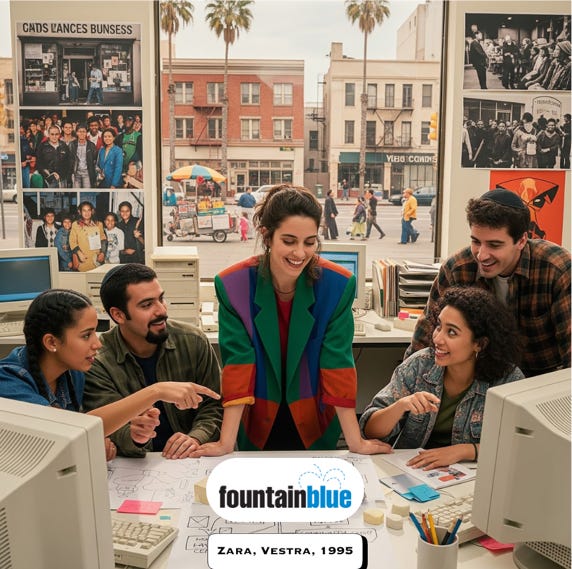
The Divide in the Mania (The Times)
The years 1995 through 2000 were defined by a profound and chaotic duality. On one side was Dot-Com Mania, fueled by a reckless ambition that prioritized “global scale or bust.” On the other hand, the financial and moral failures of the time - the scandals, fiscal irresponsibility - ignited a deep societal cynicism. This created a toxic truth: competence, honesty, and integrity were no longer rewarded. This feverish pursuit of global clicks created a massive sociological blind spot, ignoring the complex, localized needs of immigrant communities.
The government, leaders, and the booming-but-brittle economy all failed to inspire confidence; the moral chaos made people less engaged and intensely less trustful of large institutions. People felt the sting of injustice when corporate leaders were celebrated for speculative growth, cementing the belief that the system rewarded opportunism, not honesty.
The Entrepreneur’s Perspective (The Voice of Zara)
The pursuit of global clicks ignored the people right outside my door. My Israeli immigrant parents raised me with a strong sense of community and responsibility, so when I looked around Los Angeles in 1995, the disconnect bothered me deeply. The city was vibrant, sprawling, and full of cultural pockets that shaped daily life, yet none of these neighborhoods were connected digitally in any meaningful way.
I was a trained programmer and engineer, but the problems I wanted to solve were personal. My extended family lived in several of the neighborhoods that struggled most with access, visibility, and economic opportunity. They relied on local markets, community centers, and word of mouth for everything from childcare to business referrals. I wanted technology to strengthen those bonds, not replace them.
My early attempts were clumsy. My first mockups of a “local network” were so confusing that a shop owner politely asked if I had “accidentally printed the wrong diagram.” I assumed people would adopt any tool that promised convenience, but I soon learned that community trust had to be earned, not engineered. Some of my earliest outreach sessions were met with polite nods and very little engagement.
Still, Los Angeles was the perfect place to try. Every neighborhood had its own rhythm, its own language, and its own cultural gravity. If I could build something that honored these distinctions while connecting people meaningfully, the idea could work.
I leaned into the technical challenges and assembled a team of local collaborators. Vendors, entrepreneurs, suppliers, technologists, residents, and academics all contributed their insight. They were the ones who showed up, and their involvement shaped everything. We named the system Vestra as an acronym for this group, a reminder that the platform existed because the community itself built it.
At the core of Vestra was a Reputation Ledger, a running record of real interactions that turned everyday favors, purchases, and collaborations into visible trust signals neighbors could rely on. Vestra paired that with a local payment option and simple geo‑fencing so messages and offers only reached people in the nearby blocks, not the whole internet. Together, those features made Vestra feel less like an app and more like a digital town square where trust, recommendations, and money all stayed in the community.
Progress came slowly. Only a handful of stores used Vestra to promote weekend specials, and even fewer residents checked the early feed. But small signs of momentum appeared. A florist told us her neighborhood pick-up orders rose by 18 percent. A baker said Vestra saved her several hours each week by reducing phone orders. These early wins kept us moving forward.
As more people joined, Vestra became a digital gathering place for neighbors who had lived side by side for years but rarely interacted. Discussions ranged from who baked the best bread to which muralist deserved the next community project. Local service providers began shifting from expensive print flyers to ethical micro-advertising that reached only local customers.
When I pitched to local investors, they dismissed the idea entirely. One said, “There’s no scale in neighborhoods.” Another added, “The sense of community is nice, but it won’t pay.” They were looking for global numbers, not local transformation.
But I believed they were measuring the wrong things. Communities had always been the oldest and most resilient economic engine. So I stayed committed to the people who trusted us. Their belief, not investor enthusiasm, became the foundation of what we built next.
The Mentor’s Intervention (The Voice of Dr. Kofi Nkrumah, Global Philanthropist and Strategic Advisor)
I first heard about Vestra from my Bel Air neighbor, a data science professor. Though initially known for my family’s Ghanaian mining fortunes, I chose a different path: I spent decades fostering self-reliance and community-building initiatives worldwide, influencing global policy and funding critical infrastructure. That decision came with real personal blowback. My family expected me to return and resume leadership of the mining empire, and my refusal was seen as an act of betrayal — a rejection of both tradition and profit. The tension never fully faded, but I held firm. I believed that building empowered communities was a more meaningful legacy than extracting from them.
I had grown bored with the despondency and reckless promises of affluent, disconnected investors who valued revenue over rights and dollars over impact.
When I reviewed Zara’s deck, I saw investors dismissing her grassroots success as “peanuts.” My thinking was: “Peanuts, I like peanuts. They are healthy and good-for-you.” After my neighbor confirmed the verifiable proof of local loyalty and the metrics of trust were worthy of funding, I arranged to meet Zara.
I realized she wasn’t just offering a community solution. She was selling accountability and verified belonging, the very infrastructure required for ethical investment. Our hour long coffee quickly became a five hour meeting. We recognized that my expertise in legacy planning and her community model were two halves of the same strategic whole.
We agreed on Vestra’s ultimate purpose: to become the local to global engine of trust, scaling for profound global impact. I went to sleep knowing we had found the blueprint for global change.
Better Together
Dr. Nkrumah immediately saw that Vestra had something rare: it was built by the people it served, shaped by their lived experience and practical insight.
His first priority was to help Zara translate local success into a model other neighborhoods could adopt. He encouraged the team to document setup steps, common issues, and a clear launch process. Progress was slow. Zara relied on personal conversations, while the technical team wanted structure. After many long discussions, they found a balance between community voice and operational discipline.
The team focused on early wins. In the market district where Zara’s extended family worked, Vestra increased weekend vendor traffic by 27 percent within two months. Nearby specialty grocers reported smoother shared deliveries and coordinated promotions. These results showed that Vestra’s approach could be replicated.
As interest grew, Dr. Nkrumah used his network to open doors. He connected Vestra with community leaders in major U.S. cities who wanted to support local economies without depending on big platforms that offered little in return. Not every meeting was easy. Some partners doubted that a trust-based system could scale, and others questioned whether the Reputation Ledger would hold up in larger markets. Each concern pushed the team to refine onboarding, training, and data integrity.
A national nonprofit then piloted Vestra in three underserved neighborhoods. Within six months, participating markets retained more local spending, resolved customer disputes more quickly, and recorded higher trust scores. This confirmed that Vestra was not just a community experiment. It was a viable economic model.
A defining moment came when a community in Dr. Nkrumah’s home country of Ghana adopted Vestra to coordinate a neighborhood business corridor during peak tourism season. Local shop owners used it to manage foot traffic, share staff during busy hours, and run joint promotions. Revenues increased and several businesses reported their best month in years. For Zara, watching Vestra strengthen a community across the ocean revealed the broader potential of what they had built.
Together, the team proved that community connection was not a limitation but a strength. Their work showed that a neighborhood-centered system could grow sustainably, create real value, and build trust that endured.
Hope is Community:
From a thousand quiet voices, the unified anthem is forged.