


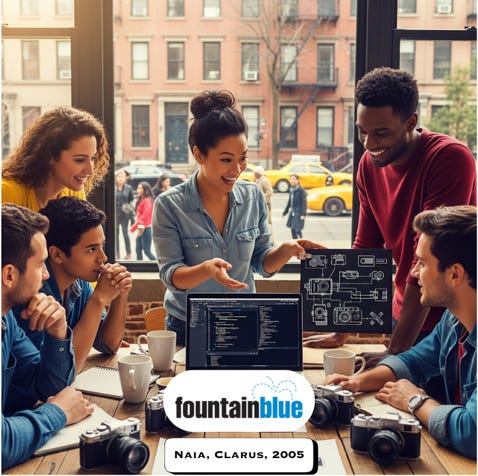
Chapter 6: The Unfiltered Feed (2005-2010)
The System, Unmasked (The Times)
The years 2005 through 2010 were defined by a sharp duality. The exhilarating technological expansion of Web 2.0 occurred simultaneously with the existential betrayal of the 2008 Financial Crisis.
This crisis served as a brutal unmasking: the financial system was built on opacity and unaccountability. The stark clarity was that the “have-nots” were forced to endure the reckless actions of financial elites. This economic betrayal fueled pervasive disillusionment.
Against this backdrop of broken trust, the digital world created its own crisis. Visual social platforms began to reward artifice, creating an epidemic of curated perfection that eroded authenticity.
The ultimate crisis was the psychological realization that the public was trapped in systems that profited from systemic deception. The urgency for uncompromised truth became an imperative.
The Entrepreneur’s Perspective (The Voice of Naia)
As a half-Jamaican, half-Chinese American living in Brooklyn in 2005, I felt constantly suspended between worlds. My days were spent inside Manhattan studios where perfection was manufactured frame by frame, and my nights belonged to Brooklyn’s raw creative spaces where artists refused to apologize for the truth. That tension sharpened my mission long before I knew I had one.
The financial crisis hit my family hard. My parents’ retirement savings evaporated because of decisions made by people who would never feel the consequences. Watching them return to work in the same media ecosystem that rewarded artifice felt like a quiet betrayal. I decided that whatever I built next would fight for authenticity.
Brooklyn became the crucible for that commitment. It was more than diverse—it was united by a shared hunger for honesty. Photographers in loft studios, coders working at kitchen tables, musicians, designers, activists, and small business owners were all wrestling with versions of the same challenge: how do you stay real in a world that profits from the opposite?
My early attempts at a tech solution were clumsy. I created filters meant to “enhance” truth, but all they did was produce softer illusions. A photographer tested one of my prototypes and told me, “Naia, this is just a nicer lie.” That feedback stung, but it helped me rise up to protect the cause.
The insight emerged slowly and soon became our rallying cry: people did not need help expressing truth — they needed protection from distortion.
That shift in understanding drew the Brooklyn community together, not as scattered helpers but as a shared movement. Each person brought something important. Photographers showed us where manipulation crept in. Coders explored ways to make images tamper-evident. Designers shaped an interface that respected identity. Activists grounded the work in ethics. It no longer felt like I was gathering volunteers; it felt like a community shaping something we all needed.
We named the system Clarus, because its purpose was clarity—to preserve what was real at the moment of capture.
To make that promise real, our coder collective built a simple but powerful safeguard. The moment a photo was taken, Clarus created a unique digital fingerprint based on its exact pixel pattern—a kind of tamper‑evident seal for images—and stored that fingerprint inside the file itself. If even one pixel changed, the fingerprint no longer matched.
The system was lightweight enough for our tiny Brooklyn setup to run, yet strong enough to reveal any attempt to retouch or filter a protected image. It made honesty verifiable — a technical backbone for the truth we were trying to defend.
Our first measurable win came at a neighborhood arts event. Clarus reduced disputes about image tampering by ninety-two percent. But the real victory was the feeling in the room—artists, organizers, and residents realized they could finally see themselves without distortion.
Momentum grew through our #GETREAL campaign, which began as a simple tag and quickly turned into a rallying cry across Brooklyn. The community saw Clarus not as a product, but as a statement of values.
A Manhattan fashion shoot gave us our first industry test. The models loved it, relieved to be portrayed as themselves. The creative director called it “the first honest lens” she had used in years.
Investors still dismissed us, saying: “No one pays for authenticity”, “People want illusions”, and “The tech isn’t strong enough.”
But Brooklyn believed.
And I believed in Brooklyn.
Clarus wasn’t the invention of a single founder. It was a community choosing honesty over performance—and building technology strong enough to defend it.
The Mentor’s Intervention (The Voice of Mr. Arthur Sterling, Retired Advertising Executive)
For twenty years, my career centered on crafting the flawless external images that dominated the media. I knew exactly how to engineer the illusion—how to polish, soften, distort, and perfect until the truth disappeared. When the financial markets collapsed in 2008, I retired disillusioned not just with the industry but with myself. I felt a quiet guilt for having helped institutionalize the very artifice that now plagued the culture. The perfection I once celebrated had become a hollow currency, and I could no longer pretend I hadn’t been part of the machine that built it.
A photographer I’d known for years introduced me to Naia. He was impressed with how Clarus’s invisible digital signature protected his work. I immediately saw common ground with Naia. We shared a fierce frustration with the phony facades that substituted for authenticity and vowed to make a difference.
I proposed a new path: pivoting from selling small content behind the #GETREAL campaign to licensing the core image verification infrastructure to advertising agencies and major brand studios in my network. This meant a new scope, traversing the nation’s creative centers—from Broadway to Hollywood.
Naia was skeptical. She was proud of her team’s progress, and questioned whether the message could remain true working with higher-profile customers and bigger projects.
Naia consulted with her team and together, they committed to the shift, but wanted to start small and transparently commit to their founding principles, as personified by the #GETREAL campaign. I was in full agreement, for different reasons.
Better Together
Naia and Mr. Sterling approached the partnership from very different worlds — she carried the moral clarity of Brooklyn’s creative community, and he carried a lifetime of experience shaping the flawless images that defined Manhattan’s advertising industry. Their goals looked different, but at the core, each of them understood the human cost of distortion.
Their first task was to translate Clarus from a grassroots movement into something that major creative centers could adopt without losing its integrity. That required navigating real tension. Sterling’s contacts expected fast delivery and polished presentations, while Naia insisted on transparency and staying loyal to the mission. More than once, Naia pushed back when an agency asked for “a softer version of the truth” or wanted Clarus to be optional. Sterling stepped in, not to override her, but to help articulate why the guardrails mattered.
The next step was to strengthen Clarus for high-volume environments. Naia’s coder collective worked with Sterling’s longtime production partners, testing Clarus on advertising shoots, film stills, and editorial photography. Early pilots showed that the system could verify the authenticity of thousands of images with less than a two percent error rate — a breakthrough for creative houses that struggled to track edits across large campaigns.
Momentum grew quickly. Sterling used his network to open doors in New York and Los Angeles, while Naia leveraged the community credibility Clarus had earned in Brooklyn. Some agencies embraced the technology immediately. Others resisted, worried that verified authenticity might disrupt established workflows or reveal the extent of their digital retouching. Each concern forced the team to refine their onboarding, simplify training, and clarify where Clarus added value rather than friction.
The breakthrough moment came when a major PR firm piloted Clarus for a celebrity-led social impact campaign. Clarus verified every released photo, ensuring that the public saw unaltered images. Engagement rates were 38 percent higher than the agency’s standard campaigns, and customer trust scores rose significantly. For the first time, a large client publicly credited authenticity as a competitive advantage.
The movement that began in Brooklyn now had national recognition. Clarus became the preferred verification layer for agencies that wanted to protect their content, safeguard their talent, and rebuild trust with audiences. The blend of Sterling’s industry reach and Naia’s unwavering mission created a powerful engine for change.
Together, they proved that authenticity was not a limitation or a trend. It was a strategic asset — one with measurable value in an industry built on perception. Clarus scaled because it stayed anchored in the community that created it and because the partnership honored the belief that truth should not have to fight alone.
Hope is Authenticity:
The only authenticity that scales is the truth you dare to live.