


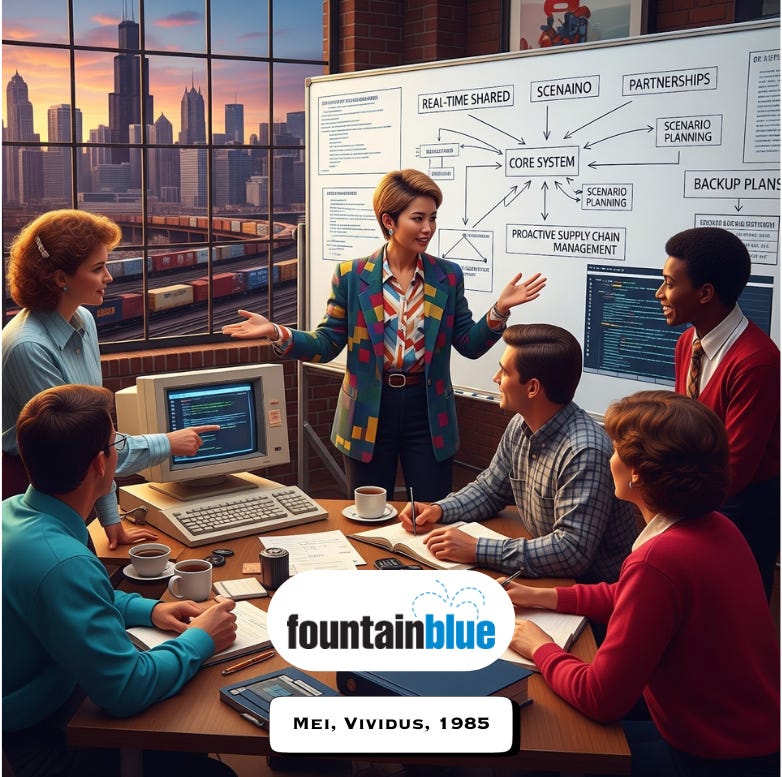
The Global Thaw: (The Times)
The years 1985 through 1990 presented a jarring contradiction: immense geopolitical optimism — the Cold War thawed, the Berlin Wall fell — juxtaposed with profound internal rot.
This external hope was repeatedly undermined by corruption and incompetence at home. The failures exposed by the Savings and Loan Crisis and widespread insider trading revealed financial markets as fundamentally dishonest. Institutional cover-ups, including those following the Challenger disaster, deepened the public’s sense of betrayal.
This moral failure was mirrored by visceral inefficiency in daily life. A global logistics infrastructure relied on mountains of paper, triplicates of forms, and slow faxes, frustrating every transaction. The prevailing feeling was a deep annoyance: a nation capable of winning the Cold War could not manage its own integrity or efficiency.
The Entrepreneur’s Perspective (The Voice of Mei)
My father’s factory in Taiwan was fueled by meticulous execution. We moved to America in 1985 seeking operational excellence.
We chose Chicago—the epicenter of American logistics—because it seemed like the perfect place to understand the machinery of global commerce.
Our first months revealed something nobody talked about: every shipment passed through too many hands, each using different forms, different rules, and different expectations. Nothing moved the same way twice. In that complexity, one of our shipments disappeared—not lost in the city, but lost in the gaps between disconnected systems.
As I researched what happened, I began spending long hours at the loading docks—dressing like the crews, learning their shorthand, and earning the trust that let me listen without judgment. In time, I could speak teamster and vendor, supplier and processor, as comfortably as I could speak to executives in a boardroom.
Each group had its own language, its own pressures, its own truths. And they had one thing in common: blame. I was good at building relationships, calming tempers, fixing my attention on the data rather than the egos. Slowly, I began untangling the process, clarifying misunderstandings, and translating expectations between groups.
I realized that blaming and distrust thrived whenever people could not see the same facts. I used that friction to define the Digital Translation Bridge, a shared dashboard that turned scattered shipment updates into one shared view so every partner could finally see the same shipment truth and understand how transparent communication could improve results. This tool later became the heart of the Vividus solution—a name blending vivid with us, symbolizing how data became vividly accessible to all of us across the partnership.
I knew I could not force collaboration, but I could provide value through Vividus if I required visibility. I won combative stakeholders over one partner at a time, showing them that sharing critical data with trusted collaborators would allow everyone to better predict and manage outcomes.
We bartered services with a consultancy to design proprietary rules for sharing, optimizing for dynamic visibility and building out the Vividus technology. Consulting projects trickled in, each showing an average 20% savings.
The Mentor’s Intervention (the voice of Julian Nowak, retired Global Strategy Executive)
A colleague told me Vividus had helped manage shipments 20% faster. Investors remained skeptical, but as a Polish immigrant who had built something from nothing in Chicago’s import-export industry, I wanted to hear the underdog’s story. I had spent two decades navigating both the high-stakes boardrooms and the loading docks — a duality that gave me a deep understanding of supply chain dynamics and strong global connections. But beneath that experience lived a long frustration: I had spent years trying to modernize our industry with simple technology solutions, only to watch my proposals dismissed in favor of short-term profits. That disappointment left me disillusioned — and hungry to help someone who still believed transformation was possible.
I retired disillusioned. The giants I served repeatedly failed to adopt simple technological solutions that would have improved efficiency, choosing short-term gains over structural integrity.
When I met Mei, I saw an opportunity to achieve what I always wanted: collaboration and peacemaking through transparent, verifiable information sharing.
We recognized we could bring the disparate parties across the ecosystem together. I proposed a partnership: my role would be to position the business to scale, while Mei provided the mission and technical rigor. Joint execution commenced.
Better Together
Julian saw immediately that Mei’s operational instincts were rare. She had learned them on the Chicago loading docks, where she dressed like the crews and spoke the language of vendors, shippers, teamsters, processors, and customers. He knew the industry needed someone who could move comfortably between the dock floor and the boardroom. With that in mind, he secured an introduction to a rapidly expanding vendor and supplier network that was preparing for global growth.
Mei presented a proactive supply chain optimization plan based on her Digital Translation Bridge. The team won a six-month consulting contract that was far more complex than any project she had handled before. Early results were strong. Shipping delays dropped by 32 percent, reconciliation errors fell sharply, and partner satisfaction improved across the board. For the first time, the different groups involved in the supply chain were working from the same operational truth.
Scaling this early success was not easy. As the team added scenario planning tools and contingency workflows to the Vividus platform, tension grew. Mei relied on intuition and direct communication, while a new product leader preferred strict processes and formal structure. Meetings often stretched late into the night as they argued about permissions, thresholds, and the exact rules for data visibility. Both sides wondered at times whether they could maintain the balance between speed and accuracy.
What kept them moving forward was the larger purpose they shared. Julian had spent his career trying to bring fairness and coordination to the import and export world, and Mei believed deeply that trust could be created through transparent systems. Together, they realized that Vividus was more than software. It was a new way of working based on clarity, honesty, and shared responsibility.
Word traveled quickly. Additional partners asked for pilots, and Julian used his international network to secure a collaboration with a global buyer whose cross-border shipments had a long history of confusion and conflict. The Vividus implementation reduced misrouted cargo by 41 percent and cut dispute resolution time by more than half. The data showed that the principles that worked in one neighborhood in Chicago could also work around the world.
The most meaningful validation came from Mei’s parents. They had crossed an ocean in search of stability and had lost everything when systems failed them. When they saw Vividus tracking shipments cleanly across the same networks that had once cost them their savings, they told Mei she had finally built the operational excellence they had always chased.
Together, Mei and Julian created a model of trust, visibility, and measurable impact. Vividus became not just a tool but a foundation for a more honest and reliable supply chain.
Their model proved that transparency is not a luxury; it is the foundation of fair trade.
Hope is Integrity:
A single, honest thread re-weaves the broken global whole.
This was Chapter Two, from Part One of Linda Holroyd’s book, Hope in an Age of Disillusionment. For more information, visit fountainblue.biz/hope.
To order YOUR copy of Hope in an Age of Disillusionment, including all the toolkits from Part Two, visit https://www.amazon.com/author/linholroyd.